Why Spot Uniformity & Energy Stability Matter in Picosecond Lasers
Topic: Picosecond lasers | Tattoo removal | Pigmentation | Carbon peel
Key focus: Spot uniformity + energy stability (real performance, not just brochure specs)
Navigation
Why Spot Uniformity & Energy Stability Matter in Picosecond Lasers
What a Simple Laser Paper Test Really Reveals
In recent years, picosecond lasers have become widely used for tattoo removal, pigmentation treatment, and carbon peel procedures. At the same time, the market has also become highly price-driven, especially in manufacturing hubs.
As a result, many devices may look similar on the surface, but perform very differently in real clinical use. This article explains why energy stability and spot uniformity are critical factors in a picosecond laser system, and why a simple laser paper test can reveal much more than it seems.
Small Tattoo Lasers vs. Full-Scale Picosecond Systems
For compact devices designed mainly for eyebrow tattoo removal or small-area treatments, controlling energy output is relatively easier:
Smaller spot size
Lower overall power demand
Short treatment duration
In these cases, basic stability is often sufficient. However, once a picosecond laser becomes a full-scale clinical system, the technical challenge increases significantly.
Large-spot, high-energy picosecond systems must handle:
Higher peak power
Longer continuous operation
Larger treatment areas
More demanding consistency requirements
This is where the real differences between machines begin to appear.
Two Critical Factors in Real Treatments
1) Energy Accuracy & Long-Term Stability
In real clinical use, energy is not just about maximum output. What truly matters is whether the machine can deliver the same energy accurately, shot after shot, over time.
Energy stability depends heavily on:
Power supply design
High-quality capacitors
Stable current output
Thermal management during long sessions
In cost-driven manufacturing, these components are often where compromises are made. The result may not be obvious immediately, but over time:
Output weakens
Treatment consistency drops
Clinical results become unpredictable
2) Spot Uniformity Across the Treatment Area
Spot uniformity is often taken for granted by experienced operators using high-quality machines. However, uniform spot distribution is not automatic.
A non-uniform spot means:
Uneven energy distribution
Hot spots in some areas
Weak zones in others
Reduced comfort and inconsistent results
Uniformity is influenced by:
Internal optical path design
Beam shaping accuracy
Alignment tolerance inside the system
Stability of the articulated arm or delivery system
These are also common areas where manufacturers reduce cost, because they are not immediately visible. But in real treatments, this “invisible difference” becomes very visible.
What a Laser Paper Test Actually Shows
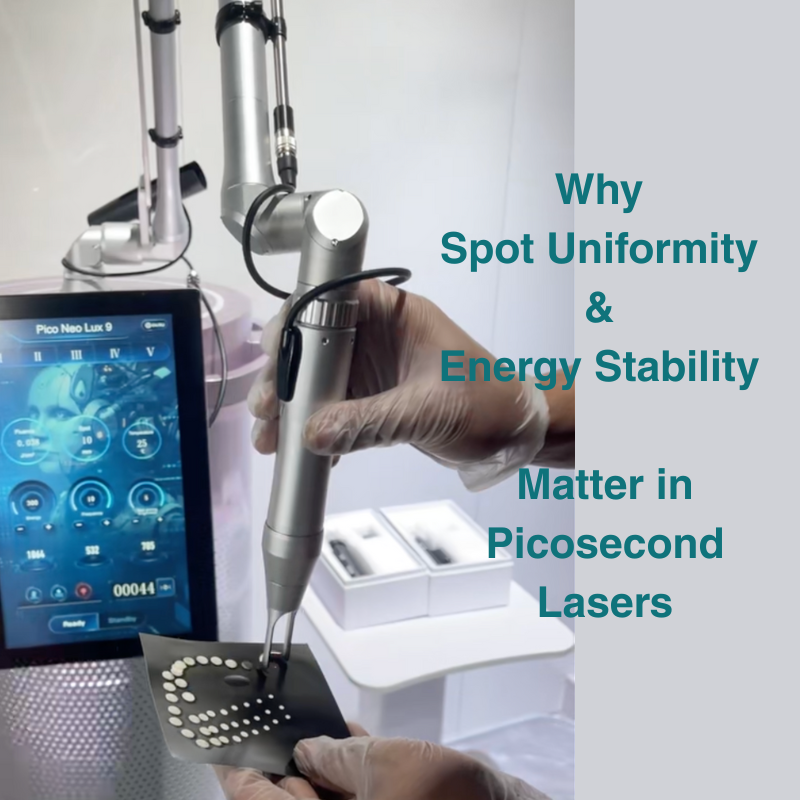
In our demonstration videos, the laser is fired rapidly onto laser test paper, producing:
Identical spot size
Consistent depth
Uniform color intensity
No visible weak or hot areas
What you see in that short video reflects a much deeper system design:
Stable power supply
High-quality optical components
Precise beam delivery
Reliable performance under continuous firing
The test looks simple, but the technology behind it is not.
Balancing Cost and Quality Responsibly
We understand that clinics and distributors worldwide are facing increasing cost pressure. Our goal is not to offer the cheapest picosecond laser, but to provide:
Reliable performance
Consistent clinical results
Reasonable pricing without sacrificing core quality
While offering competitive solutions, we continue to maintain strict standards in:
Energy control
Optical precision
Long-term system stability
Want to Understand Your Current Device Better?
If you would like:
A deeper technical discussion
An objective evaluation of your current picosecond laser
Suggestions for upgrades or replacement options
You are welcome to contact us through our website or reach out via social media. We are always happy to discuss real performance — not just specifications on paper.
📩 Contact us to continue the conversation.
WhatsApp: https://wa.me/8618633262326
WhatsApp: https://wa.me/8618633262326
© AmBeauteTech. Educational article for clinics, medspas, and distributors.