1) Why long-pulse lasers can feel better on sensitive zones
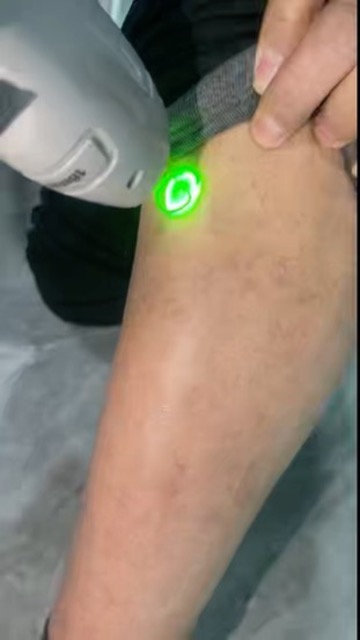
In sensitive areas (beard line, face edges, neck, chest), client comfort is often the #1 complaint. Many operators prefer a workflow that can be cleaner and quicker, without relying on thick gel.
Practical workflow: Many users simply clean the area, then treat directly with controlled settings.
Precision grooming: Popular in men’s beard-line shaping and detail work.
Client experience: When cooling and energy stability are strong, sessions can feel noticeably smoother.
Always follow local regulations and safe operation protocols. Some areas close to eyes require extra protective procedures.
2) Why premium brands can cost 10–20x more
Premium systems often charge for brand reputation, long-term clinical validation, and strong service networks. Chinese factories can offer similar technical concepts at a much lower price. The key is to spend money where it matters most: the laser source and durability design.
3) The core technology: laser source (3 must-ask questions)
Question #1: What wavelengths are inside, and is it real dual-wavelength?
Ask your supplier to confirm the internal wavelength configuration clearly. For example: 755nm + 1064nm (dual-wavelength) is often claimed in the market. You should verify it is real dual-wavelength, not a “marketing label”.
Ask for the laser source specification, source model/brand (if disclosed), and test evidence.
Ask how the device switches or combines wavelengths and what clinical purpose each wavelength serves.
Question #2: Single optical path or dual optical path (single vs dual-channel inside the source)?
Some long-pulse systems may be designed with a stronger internal optical structure (often described as dual-path/dual-channel). In practice, a stronger design can mean more stable energy and better comfort, but it typically costs more. If you are investing, investing in the laser source is usually money well spent.
Question #3: What is the warranty, and what is covered?
Many factories offer a standard 1-year warranty for the system, with some key parts covered for shorter periods. For higher-value laser sources, you can often purchase extended warranty. A common range in practice is an additional USD 300–500 per year, depending on supplier policy and parts coverage.
4) How to verify “enough energy” and stable output
“Enough energy” is not just the maximum number on a brochure. What matters is whether the device can deliver stable output during continuous operation.
Best proof: energy/power meter test
Request a short test video showing meter readings at low / mid / high settings.
Ask for repeated shots (not a single screenshot) to show consistency.
Ask for a continuous work demo (10–20 minutes) at realistic clinic settings.
Cooling and comfort checks
What cooling system is used (air/contact/water or combination)?
Does cooling stay stable after long use, or does it weaken?
Does the demo require frequent pauses (often a sign of weak cooling or unstable output)?
5) How to judge lifespan (service life) realistically
Lifespan depends on diode/source quality, cooling efficiency, and protection design. Ask suppliers to define lifespan with measurable criteria.
Lifespan definition: Is it measured by shots, hours, or output remaining above a percentage?
Protection design: temperature sensors, flow sensors, alarms, and safe shutdown logic.
Maintenance: filter cleaning, cooling maintenance, and a clear service manual.
Spare parts readiness: can they supply source/handle parts quickly if needed?
6) Buying directly from China: practical tips & risks
Buying through local distributors can be 5–10x more expensive due to local service and markup. If you have the ability to communicate clearly and verify key points, direct sourcing can be a smart option.
Always verify the core laser source details (wavelength truth, internal design, stability evidence).
Confirm warranty terms in writing, including coverage scope and response time.
Ask for operation guidance, maintenance schedule, and spare parts list before payment.
My role is to help connect overseas users with reliable Chinese factories and share practical checks like these. I also publish buyer tips on our website regularly.
Tell me your country + clinic/distributor + budget range, and I’ll match a suitable configuration.
WhatsApp: https://wa.me/8618633262326
Copy/Paste Buyer Checklist
✅ Confirm real wavelength(s) inside (e.g., 755/1064). Ask for proof, not just claims.
✅ Ask if the laser source has a stronger internal optical design (single vs dual path/channel).
✅ Request energy/power meter test video (multiple settings + repeated shots).
✅ Request continuous operation demo (10–20 minutes at real settings).
✅ Verify cooling stability during long work.
✅ Get written warranty terms, and ask if extended warranty is available (laser source coverage).
✅ Ask for maintenance guide + spare parts list + typical service response time.